




5 out of 5 stars based on 700+ reviews
Distraction Osteogenesis in Miami
Distraction osteogenesis is an advanced oral and maxillofacial surgical technique that gradually lengthens bone by slowly separating two bone segments, allowing new bone tissue to form and helping correct jaw deficiencies, improve facial balance, support airway development, and rebuild areas with limited bone volume. At Love Your Jaws, we provide expert evaluation and personalized treatment planning for children, teenagers, and adults in Miami and South Florida who may benefit from this highly specialized form of jaw and craniofacial reconstruction.
Led by Dr. Kroum Dimitrov, one of the leading oral surgeons in Miami, our team focuses on precision, safety, long-term stability, and patient-centered care. Distraction osteogenesis is not a one-size-fits-all procedure. It requires advanced diagnosis, detailed three-dimensional planning, careful surgical execution, and consistent follow-up throughout the healing process, especially for patients with jaw deficiencies, craniofacial conditions, airway problems, or bone loss that may affect function, appearance, or future dental implant planning.
Patients searching for a Distraction osteogenesis surgeon in Miami need an oral and maxillofacial surgery team that understands bone biology, facial growth, jaw function, airway anatomy, orthodontic coordination, and reconstructive planning. Here, you will find clear information on how distraction osteogenesis works, who may be a candidate, what conditions it can treat, what surgery and recovery involve, the potential benefits and risks, expected costs, our Miami service area, and why patients choose Love Your Jaws for this level of specialized care.
What Is Distraction Osteogenesis and a Distraction Device?
Distraction osteogenesis is a surgical process that gradually creates new bone by slowly separating two carefully prepared bone segments. As the bone segments move apart, the body forms new bone in the gap. This technique is also known as Bone lengthening surgery and is based on the biological principle of tension-stimulated bone regeneration.
The concept was historically influenced by the Ilizarov method bone lengthening, and distraction osteogenesis has been performed for over 100 years. The method was advanced by the Russian orthopedic surgeon Gavril Ilizarov, who showed that bone and soft tissues can regenerate when controlled gradual traction is applied. In oral and maxillofacial surgery, the same principle is adapted for the jaws, facial skeleton, alveolar ridge, and craniofacial structures.
Distraction may be used in the lower jaw, upper jaw, dental implant sites, or complex craniofacial reconstruction. Depending on the patient’s needs, treatment may involve Mandibular distraction osteogenesis, Maxillary distraction osteogenesis, Alveolar ridge distraction osteogenesis, or broader Craniofacial distraction osteogenesis.
Unlike traditional bone grafting alone, distraction osteogenesis allows the body to generate new bone while also adapting surrounding soft tissues, muscles, blood vessels, and mucosa. This makes it especially valuable in selected complex jaw and facial reconstruction cases.
Who Is a Good Candidate for Distraction Osteogenesis?
A good candidate for distraction osteogenesis is a patient with insufficient jaw length, inadequate bone height, craniofacial deficiency, airway-related jaw restriction, cleft-related maxillary deficiency, post-traumatic bone loss, or developmental jaw imbalance that may benefit from gradual bone lengthening.
Candidates may include children with congenital jaw deficiencies, teenagers with facial growth concerns, or adults needing reconstructive oral and maxillofacial treatment. In some cases, Pediatric mandibular distraction surgery may be considered for young patients with severe lower jaw deficiency and breathing concerns.
Adults may benefit when the goal is to rebuild bone for function, facial balance, dental implant preparation, or complex reconstruction. Patients searching for a Jaw bone lengthening clinic in Miami or Oral and maxillofacial surgeon for distraction care in Miami often need a detailed evaluation to determine whether distraction is more appropriate than traditional grafting or conventional jaw surgery.
At Love Your Jaws, Dr. Kroum Dimitrov evaluates facial structure, jaw position, airway anatomy, bite relationship, bone volume, dental development, and overall health before recommending this procedure. The best candidates are patients who can follow instructions carefully, attend regular follow-up visits, and commit to the full activation and healing process.
What Conditions Can Be Treated with Mandibular Distraction Osteogenesis?
Distraction osteogenesis can treat a wide range of jaw and facial skeletal conditions, including facial deformities. It is especially useful when gradual bone movement may provide better stability, soft tissue adaptation, or airway improvement than a single-stage movement.
Patients with small or underdeveloped jaws may benefit from lower jaw lengthening, especially in cases involving micrognathia of the human mandible. Families searching for Micrognathia jaw distraction in Miami often need specialized evaluation for airway, feeding, and facial growth concerns.
Distraction may also be used in Pierre Robin sequence distraction, where a small lower jaw can contribute to airway obstruction. Patients looking for a Pierre Robin sequence specialist in Miami often require coordinated care that considers breathing, feeding, growth, and surgical timing.
Other conditions may include Hemifacial microsomia jaw distraction, where one side of the face or jaw is underdeveloped, and cleft-related maxillary deficiency affecting oral and facial development, where Cleft palate maxillary advancement distraction may help bring the upper jaw forward gradually.
In selected patients, distraction can support Obstructive sleep apnea jaw lengthening when jaw deficiency contributes to airway restriction. Advanced craniofacial cases may involve procedures to expand the skull, including posterior cranial vault distraction for select patients and treatment planning for craniofacial syndromes, while dental implant planning may involve Alveolar bone height distraction when the ridge lacks sufficient height.
Complex reconstruction may also include Transport distraction osteogenesis, where a bone segment is gradually moved across a defect to regenerate missing bone. At Love Your Jaws, we determine which approach is appropriate based on each patient’s anatomy, diagnosis, and long-term goals.
How Is Distraction Osteogenesis Performed in Oral and Maxillofacial Surgery?
Distraction osteogenesis works as a staged process that includes the surgical phase, latency phase, distraction phase, consolidation phase, and device removal. Advanced imaging helps us understand bone shape, facial relationships, airway space, dental structures, and the ideal direction of movement across the craniofacial skeleton. One of the most important steps is the Vector of distraction planning, which determines the direction the bone will move during the gradual lengthening process.
During surgery, Dr. Kroum Dimitrov creates a cut bone called Corticotomy for bone distraction to mobilize the bony segments. A distractor device is then placed to guide the bone movement. Depending on the case, this may involve internal distraction devices such as an Intraoral distraction device, Internal mandibular distractor, Bone-borne intraoral distractor, Tooth-borne distraction appliance, or an External craniofacial halo distractor.
The device functions as a Rigid fixation bone distractor, stabilizing the bone while allowing controlled gradual movement. After surgery, there is a short Distraction osteogenesis latency period, allowing early healing before activation begins.
The next step is the Bone distraction activation phase, also called the distraction phase, when the device is adjusted to gradually separate the segments through gradual distraction, typically at a rate of 1 mm per day. The Maxillofacial distraction rate and rhythm must be carefully controlled to promote healthy bone formation and avoid moving too quickly or too slowly.
The biological process is known as Callus distraction bone growth, where new bone forms to fill in the gap created as the segments move apart. After the desired length or position is reached, the device remains in place during the Consolidation phase osteogenesis, supporting bone healing during the consolidation period before device removal or further treatment.
What Are the Benefits of Distraction Osteogenesis?
Distraction osteogenesis offers several important benefits for carefully selected patients. Because the bone is lengthened gradually, the surrounding soft tissues adapt over time, which may improve stability and reduce tension compared to certain movements used in traditional surgery, and many patients experience less pain with this gradual process.
This procedure may improve jaw size, facial symmetry, airway space, bite relationships, dental implant readiness, and craniofacial balance. In children, it may support facial growth and breathing when jaw deficiency is severe. In adults, it may help reconstruct bone after trauma, congenital deficiency, or long-term bone loss, sometimes with fewer demands than approaches that rely on bone grafts.
Another major benefit is the potential for improved Distraction osteogenesis orthodontic stability, especially when distraction is coordinated with orthodontic planning. For patients with insufficient bone height, alveolar distraction may create a better foundation for future dental implant placement instead of some methods used in traditional procedures.
Patients searching for Reconstructive oral and maxillofacial distraction often need a solution that addresses both structural deficiency and long-term function. At Love Your Jaws, we focus on creating treatment plans that restore function, improve facial balance, and support lasting results. In selected cases, distraction osteogenesis eliminates the need for a second surgical site and may reduce the need for additional grafting procedures.
What Is the Bone Healing Process and Recovery Like After Distraction Osteogenesis?
Recovery after distraction osteogenesis occurs in stages. Immediately after surgery, patients may experience swelling, tenderness, temporary numbness, mild bruising, soreness, and pain around the surgical site. These symptoms are expected and typically improve gradually with proper care.
During the activation phase, patients or caregivers may be instructed on how to adjust the device according to the prescribed schedule, and some patients describe these adjustments as feeling similar to having braces tightened. Follow-up visits are essential during this stage because the bone must move at the correct rate and in the correct direction.
A soft-food diet may be recommended, especially for jaw distraction procedures. Oral hygiene must be maintained carefully around the device, and patients should follow all activity restrictions and medication instructions. Once the desired movement is completed, the consolidation phase begins and typically lasts 1-3 months after distraction, allowing the new bone to strengthen before the device is removed or the next stage of treatment begins.
At Love Your Jaws, we guide every patient through the full process with clear instructions, close monitoring, and compassionate support. Because successful distraction depends on both surgical precision and patient compliance, we make sure every patient understands what to expect before treatment begins.
What Are the Risks and Potential Complications of Distraction Osteogenesis?
Like any advanced surgical procedure, distraction osteogenesis carries potential risks that should be carefully discussed before treatment begins. Fortunately, when the procedure is performed by an experienced oral and maxillofacial surgeon using meticulous planning and close postoperative monitoring, serious complications are uncommon.
Patients may experience temporary swelling, discomfort, bruising, limited jaw movement, temporary numbness, infection, delayed bone healing, or joint stiffness during the early stages of healing. Device-related concerns such as loosening, irritation of surrounding soft tissues, or the need for adjustment can occasionally occur during treatment. Improper activation or poor compliance with postoperative instructions may affect the quality of new bone formation or final alignment. Relapse occurs in 10 to 30% of cases, so planning for significant relapse is an important part of treatment design.
Although Distraction osteogenesis complications are possible, careful patient selection, accurate surgical technique, and regular follow-up visits significantly reduce these risks. Device failure rates are near 1% in mandibular distraction. At Love Your Jaws, every distraction protocol is customized according to the patient’s anatomy, age, medical history, and treatment goals. Infection rates may approach 10% in high-risk operations and are more common with external fixators than with internal distraction devices. In advanced craniofacial cases, cerebrospinal fluid leaks occur in less than 10% of cases.
Advanced digital planning, careful monitoring throughout the distraction process, and precise adjustment of the distraction device help maximize safety while promoting predictable bone regeneration. Dr. Kroum Dimitrov personally follows each patient’s healing progress to ensure the new bone develops properly and that the desired correction is achieved. Nerve injury, including risk to the inferior alveolar nerve, occurs in less than 1% of procedures.
How Much Does Distraction Osteogenesis Cost in Miami?
The cost of distraction osteogenesis varies depending on several important factors, including the location of the distraction, the complexity of the skeletal deformity, whether one or both jaws require treatment, the type of distraction device used, hospital and anesthesia fees, imaging, postoperative monitoring, and whether orthodontic care or additional reconstructive procedures are necessary.
Every patient presents with a unique diagnosis, making individualized treatment planning essential before an accurate estimate can be provided. During your consultation, we perform a comprehensive clinical evaluation, review three-dimensional imaging, explain every stage of treatment, discuss the expected timeline, and prepare a personalized treatment plan with transparent pricing.
Whenever appropriate, our team also helps patients understand insurance benefits that may apply to medically necessary reconstructive procedures involving congenital abnormalities, trauma, or functional jaw disorders, and most insurance companies may cover medically necessary distraction osteogenesis when documentation of the patient’s condition is provided.
Which Miami Areas Do We Serve for Distraction Osteogenesis?
Love Your Jaws proudly provides advanced distraction osteogenesis treatment for patients throughout Miami and South Florida from one modern oral and maxillofacial surgery center. Although we operate from a single physical location, patients regularly travel to us because they are seeking highly specialized surgical expertise and personalized reconstructive care.
Distraction Osteogenesis Treatment in South Miami
Patients from South Miami trust our practice for advanced jaw reconstruction, craniofacial surgery, airway-related jaw procedures, alveolar ridge reconstruction, and individualized distraction osteogenesis treatment planning.
Distraction Osteogenesis Treatment in Coral Gables
Families and adult patients from Coral Gables choose Love Your Jaws because of our comprehensive diagnostic approach, precision surgical techniques, and commitment to long-term functional and aesthetic outcomes.
Distraction Osteogenesis Treatment in Brickell
Patients living in Brickell rely on our experience in complex oral and maxillofacial reconstruction for personalized distraction osteogenesis procedures designed to restore facial balance, jaw function, and bone development.
Distraction Osteogenesis Treatment in Key Largo
Many patients from Key Largo travel to our Miami surgical center for highly specialized evaluation, advanced three-dimensional treatment planning, and comprehensive reconstructive oral surgery.
Distraction Osteogenesis Treatment in Pinecrest
Residents of Pinecrest appreciate our individualized care, careful surgical planning, and evidence-based approach to managing complex jaw deficiencies through gradual bone regeneration.
Distraction Osteogenesis Treatment in Fisher Island
Patients from Fisher Island choose Love Your Jaws because they value precision surgery, personalized treatment planning, and long-term follow-up provided by an experienced oral and maxillofacial surgery team.
Distraction Osteogenesis Treatment in Coconut Grove
Families and adults from Coconut Grove trust us for advanced reconstructive procedures, compassionate patient care, and customized solutions designed to improve facial function, airway health, and skeletal stability.
Why Choose Love Your Jaws for Distraction Osteogenesis in Miami?
Distraction osteogenesis is one of the most technically demanding procedures in oral and maxillofacial surgery. Achieving successful patient outcomes requires a thorough understanding of craniofacial anatomy, bone biology, facial growth, orthodontics, airway function, and long-term skeletal stability. Choosing the right surgical team is essential.
At Love Your Jaws, every distraction osteogenesis procedure begins with comprehensive evaluation, advanced digital imaging, and individualized surgical planning. We believe that every patient deserves a treatment plan specifically designed around their anatomy, diagnosis, functional needs, and long-term goals rather than a standardized surgical approach.
Dr. Kroum Dimitrov is recognized by many patients as one of the leading oral surgeons in Miami for complex jaw reconstruction and advanced oral and maxillofacial surgery. His meticulous attention to detail, commitment to evidence-based treatment, informed by published research including systematic review literature in complex cases, and patient-first philosophy help ensure that each procedure is performed with the highest level of precision and safety.
Our practice combines modern surgical technology with personalized care throughout every stage of treatment. Whether distraction osteogenesis is recommended for congenital jaw deficiencies, craniofacial reconstruction, airway improvement, bone regeneration, or implant site development, we carefully guide patients from diagnosis through final healing with continuous communication and close postoperative follow-up.
Patients searching for a Mandibular distraction surgery doctor in Miami, Craniofacial distraction specialist in Miami FL, or Pediatric maxillofacial distraction in Miami consistently choose Love Your Jaws because we provide comprehensive care built on experience, compassion, and outstanding clinical outcomes. Families looking for information related to Nicklaus Children’s Hospital distraction osteogenesis or the University of Miami craniofacial distraction program frequently seek our expertise for second opinions or personalized surgical evaluations. Our team is committed to delivering world-class care that restores facial function, supports healthy bone development, and helps every patient achieve long-lasting confidence and quality of life.
Frequently Asked Questions
Yes. In carefully selected patients, distraction osteogenesis can be an excellent alternative to traditional surgery. Instead of repositioning the jaw in a single procedure, distraction osteogenesis gradually creates new bone while slowly moving the jaw into its desired position, helping lengthen bones while surrounding soft tissues adapt. This technique is particularly valuable for patients with severe jaw deficiencies, congenital craniofacial conditions, significant facial asymmetry, or growing children whose skeletal development is still ongoing. During your consultation at Love Your Jaws, Dr. Kroum Dimitrov will determine whether distraction osteogenesis or conventional jaw surgery offers the safest and most predictable long-term outcome for your individual condition.
The complete distraction osteogenesis process usually takes several weeks to several months depending on treatment complexity and the patient’s condition. The stages are completed in order: surgical phase, latency phase, distraction phase, consolidation phase, and device removal. Every patient’s timeline is different, but regular follow-up visits allow our team to monitor healing and make adjustments whenever necessary to achieve the best possible result.
In many cases, no visible facial scars are present because distraction osteogenesis can often be performed inside the mouth using intraoral surgical techniques, and in selected cases this approach can also support bone development for dental implants. When external devices are required for certain complex craniofacial cases, small skin incisions may be necessary, but our surgical approach is always designed to minimize scarring while maximizing functional and aesthetic outcomes. At Love Your Jaws, careful surgical planning helps preserve natural facial appearance throughout the treatment process.
Absolutely. Although distraction osteogenesis is widely used in pediatric craniofacial surgery, adults with jaw deficiencies, facial asymmetry, bone loss, traumatic deformities, or airway problems may also benefit from this advanced procedure. Adult treatment plans are carefully customized according to bone quality, overall health, facial anatomy, and long-term treatment goals. Our team evaluates every patient individually to determine the most effective surgical approach.
Many patients benefit from orthodontic treatment before, during, or after distraction osteogenesis. Braces or clear aligners help coordinate tooth movement with skeletal correction, ensuring that the bite functions properly once the jaw has reached its final position. We work closely with your orthodontist whenever multidisciplinary treatment is recommended to achieve optimal functional and cosmetic results.
When properly planned and performed, distraction osteogenesis produces permanent new bone that becomes part of the patient’s natural skeleton. Once healing is complete, the regenerated bone fills the gap created during treatment and continues to function like normal bone. Long-term stability depends on factors such as proper surgical planning, patient compliance, orthodontic treatment when indicated, and routine follow-up care. Our goal is to create lasting improvements in facial balance, jaw function, and overall oral health.
Yes. While distraction osteogenesis is primarily performed to restore function, improve airway health, or correct skeletal deficiencies, it often produces significant aesthetic improvements as well. By gradually lengthening deficient facial bones, the procedure can enhance facial symmetry, improve jaw projection, balance facial proportions, and create a more harmonious profile. Every treatment plan is designed to optimize both function and appearance whenever possible.
Most patients temporarily follow a soft-food diet while the jaw heals and new bone develops. Foods that require excessive chewing should be avoided until your surgeon confirms that adequate healing has occurred. Maintaining excellent nutrition during recovery supports healthy bone regeneration and tissue healing. Our team provides detailed dietary recommendations that are customized for each phase of your recovery.
Regular follow-up appointments are one of the most important parts of successful distraction osteogenesis. During these visits, we evaluate bone formation, monitor the distraction device, verify proper jaw movement, and make any necessary adjustments. The exact schedule varies for every patient, but close monitoring helps ensure safe healing and optimal long-term results while reducing the risk of complications.
Distraction osteogenesis requires extensive experience in oral and maxillofacial surgery, advanced digital treatment planning, and a thorough understanding of craniofacial anatomy. At Love Your Jaws, every patient receives a fully customized treatment plan developed by Dr. Kroum Dimitrov, one of Miami’s leading oral surgeons. We combine modern surgical technology, meticulous planning, personalized care, and comprehensive postoperative monitoring to deliver predictable, long-lasting results. From your initial consultation through complete recovery, our team is committed to helping you achieve improved jaw function, facial balance, and a better quality of life.
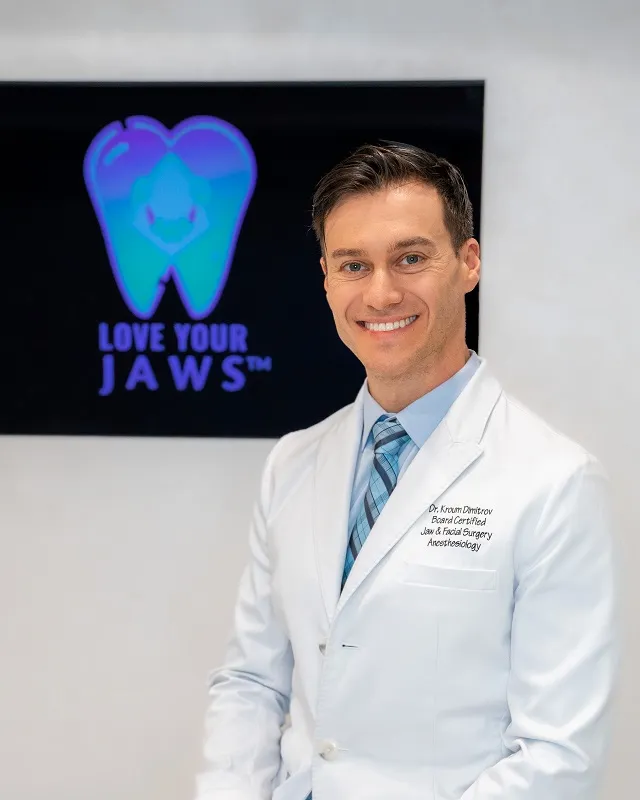
Meet Dr. Kroum Dimitrov.
Professor's Cup Award recipient - recognized for academic and surgical excellence.
Dr. Dimitrov is one of the few dual-certified specialists in Miami-Dade - holding board certifications in both Oral & Maxillofacial Surgery (ABOMS) and Anesthesiology. This combination means a single trusted expert oversees every aspect of your care, from your first consultation through your recovery follow-up.
When you're at Love Your Jaws, you're treated by the doctor - not handed off to an associate or a rotating staff member. Every procedure - from a single wisdom tooth to a full-arch reconstruction - is personally performed by Dr. Dimitrov in our Miami surgery center.
- Board Certified by American Board of Oral and Maxillofacial Surgery (ABOMS)
Board Certified by National Dental Board of Anesthesiology (NDBA)
- Hospital privileges: Baptist Hospital · Doctors Hospital
- Trained: University of Miami / Jackson Memorial Hospital, Chief Resident
- AAOMS Member · ADSA Member