




5 out of 5 stars based on 700+ reviews
Anesthesia is a fundamental component of modern oral and maxillofacial surgery. It refers to the use of medications to prevent pain and manage anxiety during surgical procedures. Unlike general dentistry, which primarily utilizes local numbing, oral surgery often requires a sophisticated spectrum of anesthesia to ensure patient comfort during more complex treatments.
At Love Your Jaws, we view anesthesia as a personalized experience. Whether you are coming in for a simple extraction or a complex jaw reconstruction, our goal is to match the level of anesthesia to your specific physiological and emotional needs.
The Spectrum of Care: From Local Numbness to Deep Sleep
Anesthesia in oral surgery is not a “one size fits all” approach. It is categorized by the level of consciousness and pain relief it provides:
- Pain Blockage (Analgesia): Preventing the brain from perceiving pain signals from the surgical site.
- Anxiety Relief (Sedation): Calming the nervous system so you feel relaxed and indifferent to the procedure.
- Controlled Sleep (General Anesthesia): Ensuring you are completely unaware and have no memory of the surgery.
Comparing Anesthesia Methods
The following table outlines the common sedation and anesthesia techniques used in our practice to help you understand what to expect.
| Method | Description of Technique | Usual Indications |
| Local Anesthetic | You remain fully conscious. Lidocaine is administered to the specific surgical site to numb the area. | Minor soft tissue procedures and simple tooth extractions. |
| Nitrous Oxide (Laughing Gas) | A mixture of nitrous oxide and oxygen is inhaled. You remain conscious but in a deeply relaxed state. | Simple to moderately involved procedures, including wisdom teeth and implants. |
| IV Sedation / General Anesthesia | Medications are administered intravenously. You fall into a deep sleep and are unaware of the procedure. | Most wisdom teeth removals, dental implants, or for patients with high dental anxiety. |
| Hospital-Based Anesthesia | Anesthesia is administered by an anesthesiologist in a hospital or surgical center setting. | Extensive jaw reconstructions, TMJ surgery, or patients with complex medical conditions. |
Expert Qualifications & Safety Standards
Safety is our hallmark. To administer office-based general anesthesia, our specialists have completed extensive hospital-based anesthesia training. Our facility undergoes rigorous evaluations by state dental board examiners to ensure all monitoring devices and emergency equipment meet the highest medical standards.
When you choose Love Your Jaws, you choose a team that is licensed, highly trained, and dedicated to the highest protocols of patient care.
Why is Anesthesia Necessary?
Beyond simple pain management, anesthesia serves several critical functions:
- Patient Cooperation: It allows patients with high dental phobia or a strong gag reflex to receive necessary care without distress.
- Surgical Precision: When a patient is relaxed or asleep, the surgeon can perform intricate tasks with greater speed and accuracy.
- Safety: Modern anesthesia involves the continuous monitoring of vital signs—heart rate, blood pressure, and oxygen levels—ensuring the body remains stable throughout the procedure.
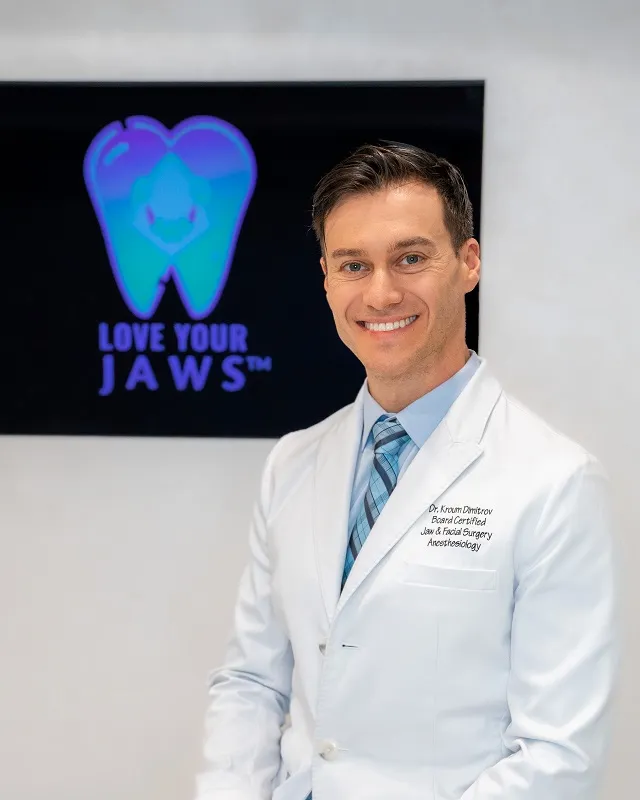
Meet Dr. Kroum Dimitrov.
Professor's Cup Award recipient - recognized for academic and surgical excellence.
Dr. Dimitrov is one of the few dual-certified specialists in Miami-Dade - holding board certifications in both Oral & Maxillofacial Surgery (ABOMS) and Anesthesiology. This combination means a single trusted expert oversees every aspect of your care, from your first consultation through your recovery follow-up.
When you're at Love Your Jaws, you're treated by the doctor - not handed off to an associate or a rotating staff member. Every procedure - from a single wisdom tooth to a full-arch reconstruction - is personally performed by Dr. Dimitrov in our Miami surgery center.
- Board Certified by American Board of Oral and Maxillofacial Surgery (ABOMS)
Board Certified by National Dental Board of Anesthesiology (NDBA)
- Hospital privileges: Baptist Hospital · Doctors Hospital
- Trained: University of Miami / Jackson Memorial Hospital, Chief Resident
- AAOMS Member · ADSA Member